An AI SRE is software that helps engineering teams investigate production incidents, gather operational evidence, test likely causes, and return a root cause explanation for human review.
Consider a payments outage where dashboards stay green while customers still see failures at checkout. On-call engineers jump between traces and logs, tweak feature flags, add extra logging, then wait through redeploys just to catch the one value that finally explains the failure. In that moment, the label on the tool matters less than the signals or runtime state it can point to when it explains what went wrong.
The next step is to ask what work this software can handle during an incident and what still sits with the on-call engineer.
What does an AI SRE do
During an incident, on-call engineers try to answer a simple question: what broke and why. An AI SRE joins that work as another teammate, only it is software that can read more signals, faster than a person can.
The AI SRE starts from the alert. It reads the message, checks which services are involved, and pulls related logs, metrics, and traces into one view. Instead of clicking through several dashboards, the responder sees one place where symptoms line up.
From there, the system looks for patterns. It can connect a spike in errors in one service to a slow dependency upstream, a recent deploy, or a change in traffic. It tests different explanations against the data and keeps the ones that match what the signals show.
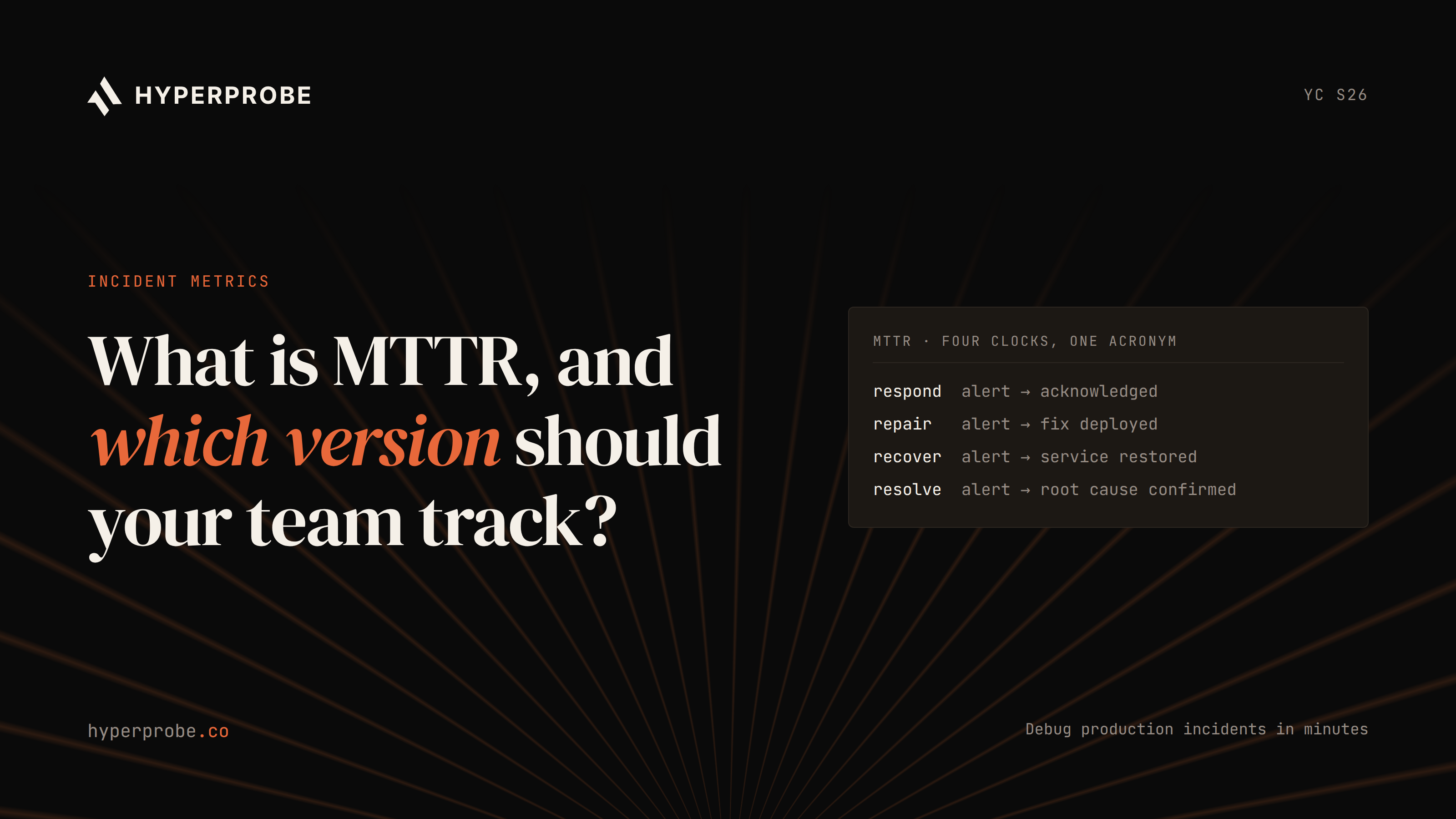
The goal is a clear root cause, not just a list of symptoms. Root cause analysis (RCA) means finding the exact condition that led to the user-visible failure, such as a wrong flag value, a missing field, or a bad rollout step. Mean time to resolution is the time between the first signal of trouble and full recovery, and faster, better evidence is what brings that number down.
This work depends on observability. Logs, metrics, and traces are how a team understands a running system. Application performance monitoring (APM) tools track latency, errors, throughput, and service health, and they provide the record that an AI SRE reads from.
Some of the most expensive failures never wake a pager. A silent bug can return a 200 status with the wrong response body and still hurt revenue, trust, or data quality. An AI SRE can help here as well by watching for patterns in telemetry that hint at trouble, then pointing engineers to the services and requests that deserve a closer look.
How is AI SRE different from SRE?
AI SRE is different from SRE because AI SRE is a software category, while site reliability engineering is a human operating discipline.
A site reliability engineering team (SRE) owns reliability decisions. It decides escalation policy, risk tolerance, service-level objectives, incident command, rollback authority, and post-incident work. The team is accountable to customers and the business.
An AI SRE does not carry that accountability. It can reduce the manual investigation burden, but it does not become the owner of production. AI SRE as a tool changes how evidence is gathered and reasoned over during an incident. It does not remove the need for an on-call rotation, a release process, or engineering judgment.
Where does an AI SRE get evidence
An AI SRE gets evidence from one of two places:
- data the customer already collected,
- or new evidence captured from the running service during the incident.
AI SRE tools reason over logs, traces, metrics, alerts, deployment events, service topology, cluster state, runbooks, incident history, tickets, and code context. That evidence can be rich. It can reduce noise, connect events that humans would inspect across several screens, and produce a clear hypothesis faster than a tired responder at 2 a.m.
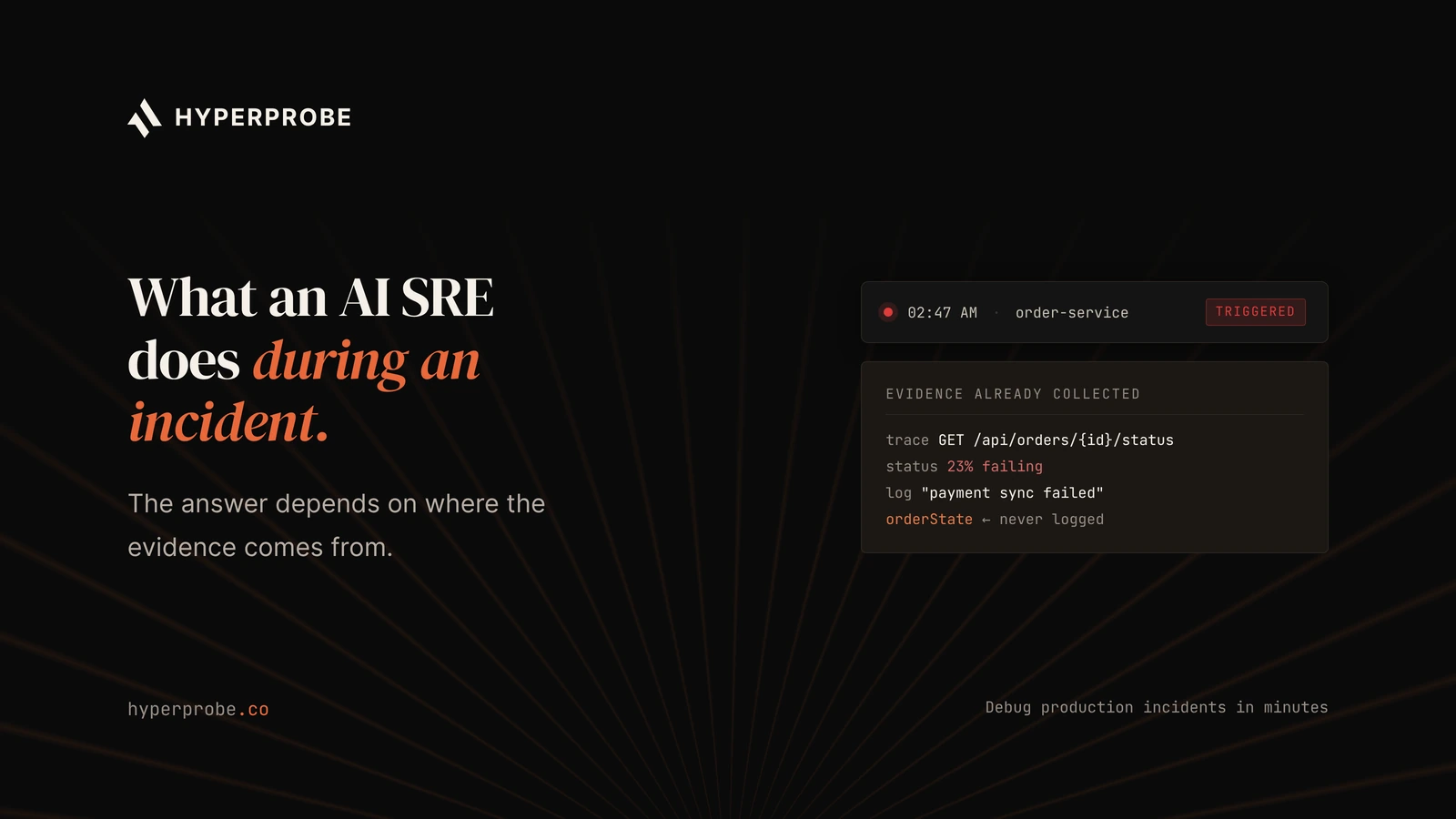
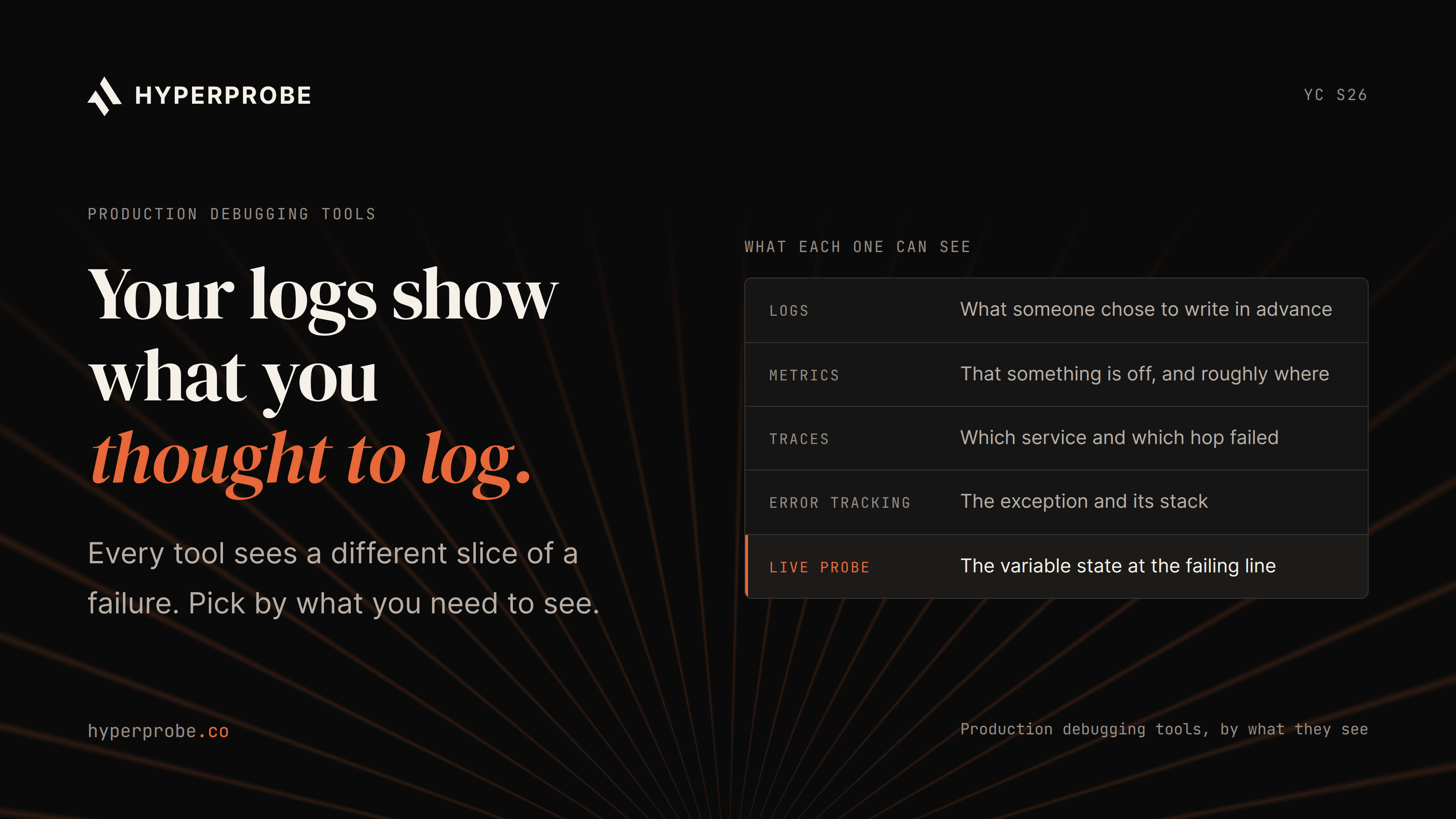
The limit here is simple. When an AI SRE only reads logs and traces that already exist, it can only prove causes that show up in that record. If the one value that explains the failure was never logged, more analysis on the same data still leaves the team guessing.
A second approach collects fresh evidence from the live service while the failure is happening. This is how HyperProbe works as an AI on-call agent, watching code-level state on real requests instead of relying only on past logs. It can capture the exact variable value, branch choice, or returned payload at the moment things go wrong, even when no log line ever recorded that detail.
The table compares the two classes by the evidence behind the conclusion.
| Attribute |
Reasoning over existing data |
Capturing new runtime evidence |
| Evidence source |
Logs, traces, metrics, alerts, topology, events, runbooks, tickets, and prior incidents. |
Live code-level state from the running service during the faulty condition. |
| Useful when |
The cause is already reflected in telemetry or operational history. |
The cause depends on data that was not logged or traced. |
| Hard limit |
The system cannot prove a cause that the collected data does not support. |
The system needs the condition to occur while capture is active. |
| Root cause confidence |
Confidence comes from correlation and consistency across existing signals. |
Confidence comes from observing the failing state directly. |
| Operational implication |
Investigation gets faster when telemetry already contains the answer. |
Investigation gets stronger when the answer was missing from telemetry. |
Evidence quality decides the value of the category. The wrong class can make an investigation look sophisticated while still leaving the team with a guess.
Does AI SRE replace observability?
AI SRE does not replace observability because observability supplies production signals that engineering teams still need before, during, and after incidents.
Observability tools and APM systems show what changed. They surface elevated error rates, slow endpoints, failed dependencies, and unusual traffic patterns. They also provide the historical record that engineers use in reviews and post-incident work.
AI SRE sits in the investigation layer. One class reasons over the evidence those systems already collected. Another class adds missing evidence when the collected data is not enough. The buyer should not treat those as the same purchase, because one depends on the telemetry record and the other can add to it while the service is still running.
HyperProbe is an AI on-call agent, and sits alongside an existing observability and alerting stack.
With live production debugging, built on dynamic instrumentation, HyperProbe captures evidence from the running service rather than inferring a cause from data already collected.
What can AI SRE not do
AI SRE has clear limits. Those limits come from the kind of evidence the tool can see.
- Capture-class tools:
- Cannot replay an incident that is already over
- Can only capture the next occurrence, or a condition that is still active
- Cannot create runtime state that no longer exists
- Reasoning-class tools:
- Work on history that already exists in logs, traces, metrics, deploy events, and tickets
- Can rebuild a likely sequence for many incidents
- Still stay within the bounds of what those systems stored
Some problems also sit outside both classes. DNS changes, load balancer rules, credential stuffing, billing provider policies, and account-level rate limits do not live in code-level state inside the service. They may show up as symptoms in the app, while the true cause sits outside the running code path.
AI SRE also should not be treated as an automatic production author. The system can confirm the cause and give the engineer the evidence needed to act. The engineer commits the fix, reviews the risk, and owns the change.
For a security-gated account, the boundary between diagnosis and the fix is often what lets the category pass review.
When does a team need AI SRE
A team needs AI SRE when incident work keeps pulling senior engineers away from product and reliability.
The pattern usually looks like this:
- After every alert, the same people join the call. They are staff or principal engineers who should be unblocking roadmaps, not staring at dashboards.
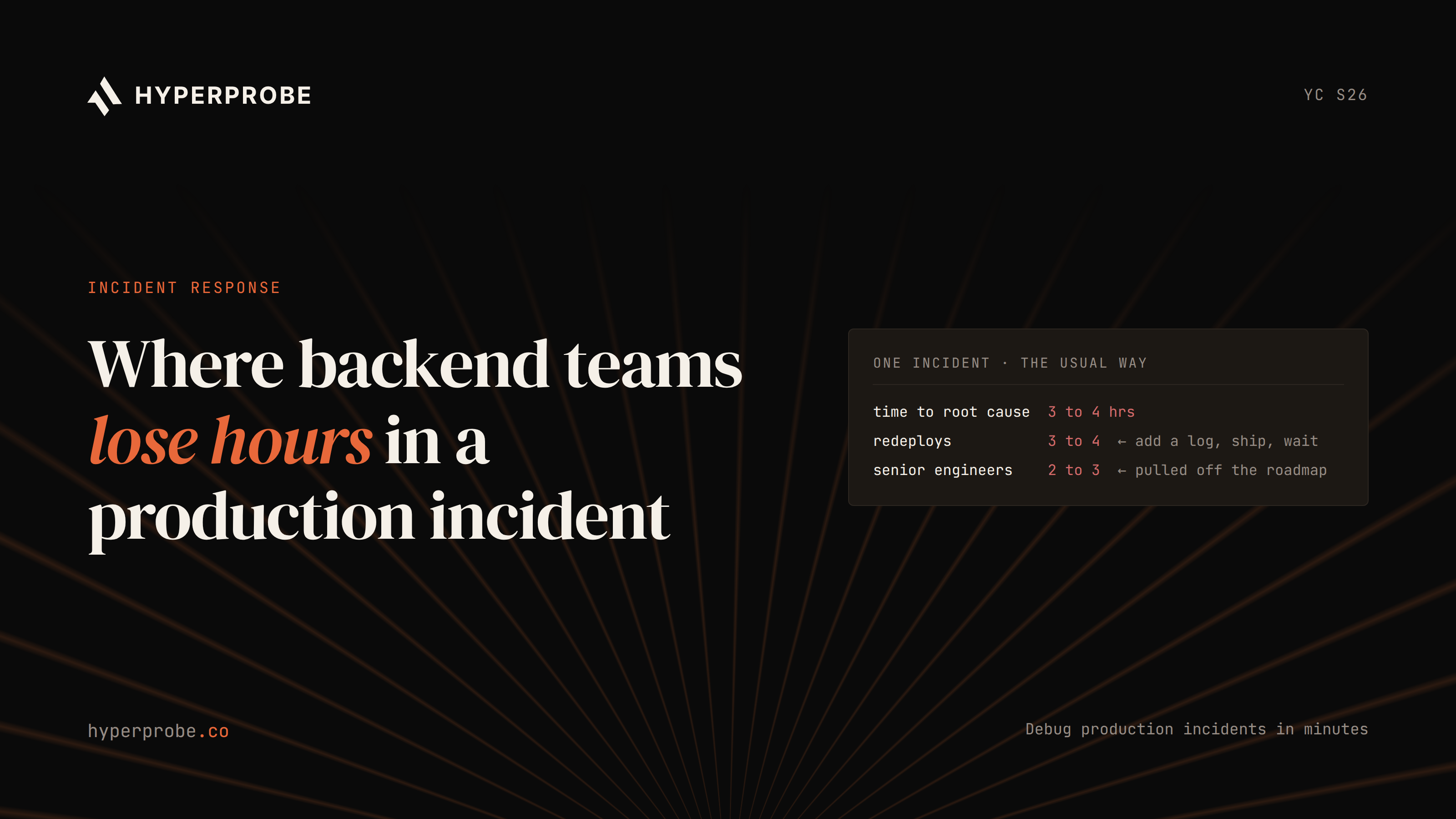
- The group spends more time hunting than fixing. They add logs, wait for redeploys, and still debate what actually broke.
- Incidents blur into each other. Similar pages fire again because no one had enough evidence to close the root cause with confidence.
Each redeploy cycle costs thirty minutes to two hours. That time stings when the only goal is to add evidence that should have been available while the service was failing.
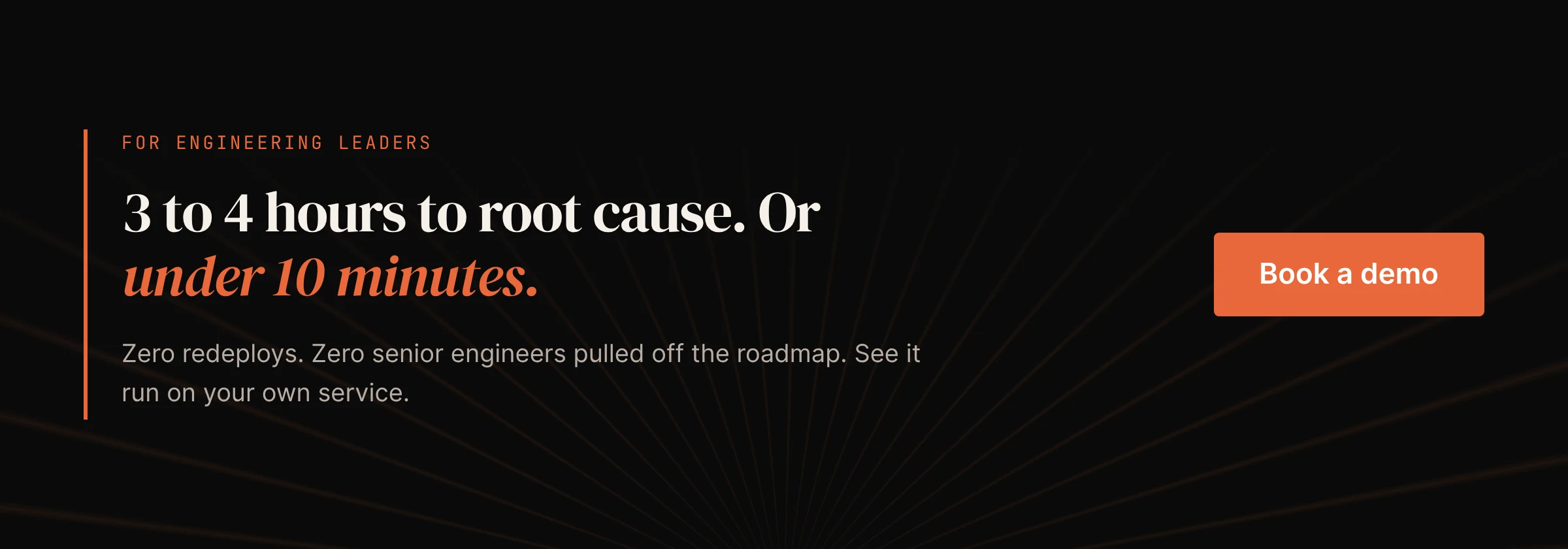
In one set of incidents, HyperProbe has seen root cause confirmed in under ten minutes instead of three to four hours. Redeploy cycles dropped from several per incident to none, and senior engineers no longer needed to join every call. These are the kinds of changes that show an AI SRE is doing useful work, not just adding another dashboard.
The purchase decision is evidence
A practical way to read AI SRE is through its evidence path. The helpful question is how the system gets from a symptom to a confirmed cause, and which signals it can point to along the way.
Reasoning over existing telemetry fits teams whose logs, traces, and metrics already hold the answers for most incidents. In that setting, the value comes from organizing what you have, cutting noise, and shortening the path to the same root cause your responders would have found by hand.
Capturing new runtime evidence fits teams that often redeploy only to add missing context. Here, the value comes from seeing code-level state while the failure is still live, so the answer exists even when nobody thought to log it.
Those two paths show up differently in reviews. One choice leans on the quality of the current observability record. The other leans on the ability to observe fresh state from running services. In both cases, the outcome that matters is simple: a clear cause, fewer redeploy cycles, and less senior time spent in incident calls.
Book a working session on a live incident