Best AI incident management platforms for 2026

Quick Answer
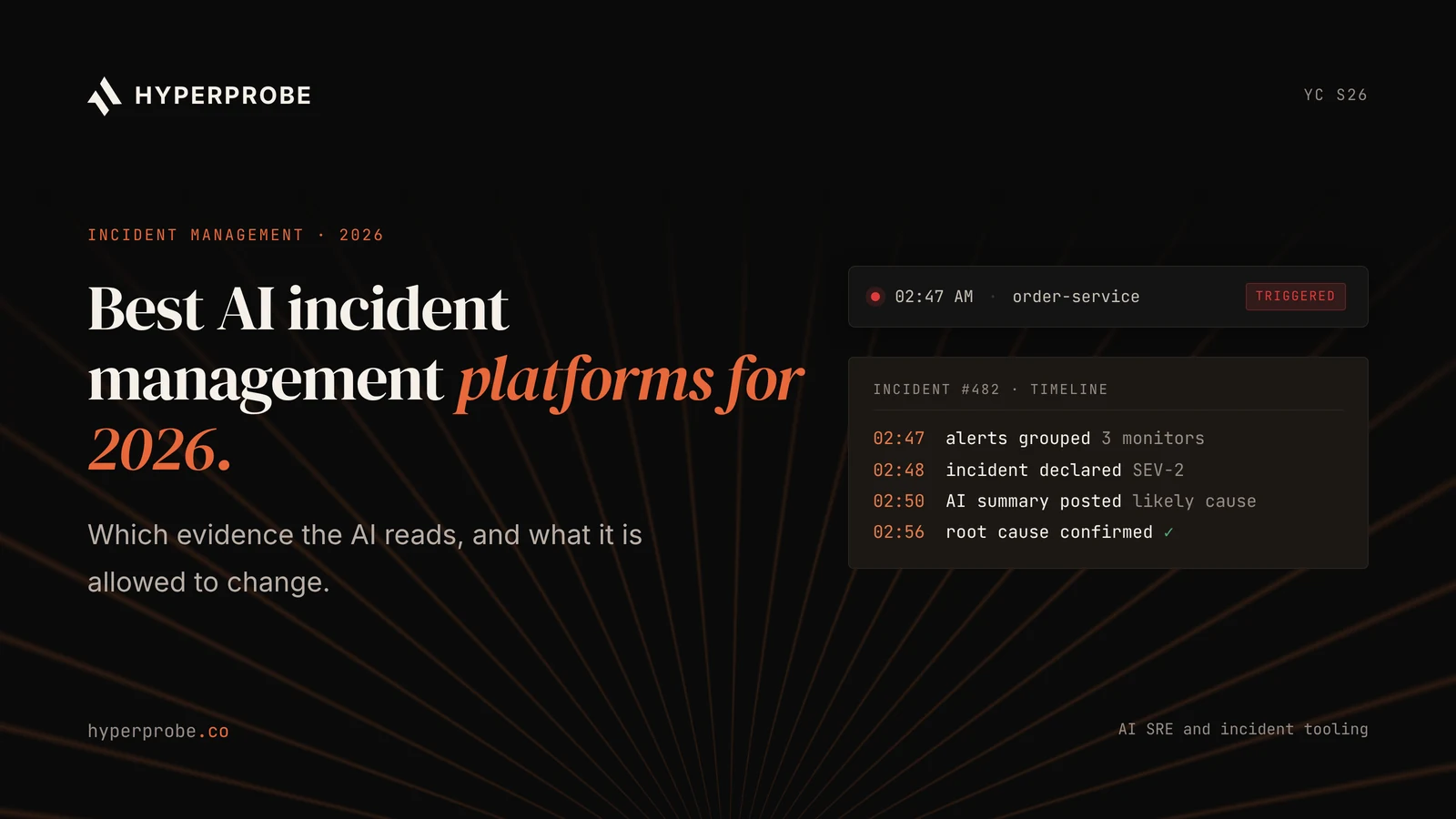
The best AI incident management platforms for 2026 are incident.io, PagerDuty, Rootly, Datadog Incident Response, FireHydrant, Grafana IRM, ilert and Jira Service Management, with HyperProbe as the investigation layer beside them. Every platform now summarizes incidents and drafts updates. Choose on what sits underneath that AI layer: which evidence the AI reads, what it is allowed to change, and how the bill counts seats and AI usage.
The best AI incident management platforms for 2026 are incident.io, PagerDuty, Rootly, Datadog Incident Response, FireHydrant, Grafana IRM, ilert and Jira Service Management. Each one now ships an AI layer that summarizes incidents, drafts updates and proposes a likely cause. The differences that matter to a budget owner sit underneath that layer: which evidence the AI reads, what it is allowed to change, and how the bill counts seats and AI usage.
An incident management platform is software that pages responders, opens a channel, tracks roles and timelines, and produces the postmortem. The AI layer sits on top. A platform that reads only chat history will summarize well and diagnose poorly. A platform that reads telemetry, deploys and code has a better chance at the cause.
Which AI incident management platforms lead?
Eight AI incident management platforms lead in 2026 on AI depth, adoption and pricing clarity, and HyperProbe is added as the investigation layer that works beside them. The table below lists each platform, the evidence its AI reads, the list entry price and the team it suits.
| Platform | Evidence the AI reads | Entry paid price (list) | Best for |
|---|---|---|---|
| HyperProbe | Live variable state captured from running code | Per service, unlimited probes and captures | Adding code-level evidence beside your incident platform |
| incident.io | Incident history, telemetry, deploys, code | $15 per user per month annual, on-call extra | Slack or Teams native response with AI investigation |
| PagerDuty | Alerts, incident history, runbooks, change events | $21 per user per month annual | Enterprises with complex paging and automation |
| Rootly | Telemetry, deploys, past incidents | $20 per user per month, on-call and AI SRE extra | Teams that want chat-native workflows with deep automation |
| Datadog Incident Response | Metrics, logs and traces stored in Datadog | $20 per On-Call seat per month, AI on credits | Teams already on Datadog |
| FireHydrant | Incident history and chat context | $25 per responder per month | Teams also buying Freshworks ITSM |
| Grafana IRM | Grafana metrics, logs and traces | $20 per active user plus $19 platform fee | Teams standardized on Grafana Cloud |
| ilert | Logs, metrics, deploys and config changes | €19 per user per month annual | European teams with data residency needs |
| Jira Service Management | Tickets, alerts and Atlassian context | About $20 per agent per month | Atlassian shops leaving Opsgenie |
Prices are list prices from vendor pricing pages and public comparisons in November 2026. Negotiated contracts differ, and several AI features are priced by quote.
What is AI incident management?
AI incident management is the use of language models and machine learning inside the incident response workflow to cut the manual work between the first page and the final postmortem. It covers four jobs, and each platform does them to a different depth.
- Noise reduction. Grouping related alerts so responders see one incident instead of forty pages.
- Coordination. Opening channels, assigning roles, writing status updates and keeping the timeline.
- Investigation. Reading telemetry, deploys and past incidents to propose a likely cause with evidence.
- Learning. Drafting the postmortem and linking the incident to similar ones from the past.
Coordination and learning are mature. The platforms on this list all draft summaries and postmortems, which responders then review and edit. Investigation is where the claims diverge. Rootly's own guidance on AI SRE notes that root cause is rarely a fact a model can read directly from a dashboard, and that the defensible output is a likely-cause hypothesis supported by evidence. That framing is the right one for a buyer.
The category overlaps with AI SRE, which HyperProbe's AI SRE explainer defines in full. Incident management platforms own the response workflow. AI SRE tools own the investigation. Several vendors now sell both.
How were these platforms evaluated?
These platforms were evaluated on six criteria that decide whether the AI saves engineering time or adds review work. The list below states each criterion.
- Evidence used. Which sources the AI reads: chat, alerts, telemetry, deploys, code or past incidents.
- Actions allowed. Whether the AI only suggests, or can also run automations, roll back or page people.
- Approval. Whether a human must approve each action, and whether approval rules are configurable per team.
- Audit trail. Whether every AI step, source and decision is logged and reviewable after the incident.
- Deployment model. SaaS only, regional hosting, or a self-managed option.
- Pricing clarity. Whether seat, on-call and AI prices are published, or sales-led.
Each platform below follows the same structure: best for, what it does, strengths, limits and public pricing.
What does each AI incident platform do?
1. HyperProbe
Best for: Teams that already have an incident platform and need code-level evidence when logs and traces stop short.
What it does: HyperProbe is an AI on-call agent for live production debugging, built on dynamic instrumentation. When an investigation narrows the cause to a function, it places a read-only probe on the suspect line and captures variable state the next time that line runs. The evidence goes back into the incident for the AI and the responder to reason from.
Strengths: Probes do not pause production, change source code or require a redeploy. PII is redacted at the agent, probes self-clear on a time and rate limit, and enterprise teams can run in a private VPC or self-hosted.
Limits: HyperProbe does not page responders, run incident channels or write status updates, so it complements a platform from this list rather than replacing it.
Public pricing: Pricing is per service, with unlimited probes and captures on every tier, so cost does not grow with incident count or seat count.
2. incident.io
Best for: Engineering teams that run incidents in Slack or Microsoft Teams and want AI investigation inside the same workflow.
What it does: incident.io covers on-call, incident response, status pages and postmortems. Investigations became generally available on August 5, 2026. It starts when an incident is declared, posts a first summary in the channel and keeps updating as evidence arrives.
Strengths: Investigations is built on Nexus, which models each customer's systems, teams and incident history and reasons across telemetry, deployments and code. Investigations shows the sources it used and the theories it rejected, so responders can challenge a conclusion. Pricing is published per user.
Limits: The AI is strongest when most of the response already runs inside incident.io. On-call is a separate per-user add-on, so the all-in seat price is higher than the headline. The AI reasons over data that already exists in connected tools.
Public pricing: incident.io offers a free Basic plan. Team is $15 per user per month on annual billing, plus $10 per user for on-call. Pro is $25 per user per month, plus $20 per user for on-call. Enterprise is sales-led. Confirm during procurement which AI features each tier includes.
3. PagerDuty
Best for: Large organizations with complex escalation policies, many integrations and an existing automation practice.
What it does: PagerDuty pages responders, routes events and runs incident workflows. On November 3, 2026, PagerDuty introduced Paige, an AI agent that joins an escalation policy as a virtual responder and investigates alerts before they become incidents. The platform was renamed the PD Reliability Platform at the same launch.
Strengths: PagerDuty has more than 700 integrations and a long incident history to learn from. Paige's Deep Investigation tests several root-cause hypotheses at once and ranks them by confidence. Teams set Paige's permissions team by team, which gives the approval control a security reviewer will ask for.
Limits: The headline seat price excludes several add-ons. AIOps noise reduction is licensed separately, and status pages are an add-on below Enterprise. Paige is new as of this writing, so production references are limited.
Public pricing: PagerDuty has a free plan for up to 5 users. Professional is $21 per user per month on annual billing ($25 monthly). Business is $41 per user per month on annual billing ($49 monthly). Enterprise, AIOps and AI agent pricing are sales-led.
4. Rootly
Best for: Teams that want chat-native incident response with heavy workflow automation and a separate AI SRE product.
What it does: Rootly runs incidents in Slack or Teams, with workflows, roles, status pages and retrospectives. Rootly's AI SRE correlates telemetry, recent deploys and past incidents, then posts a root-cause hypothesis with linked evidence, such as the suspect pull request and the matching error signature.
Strengths: The workflow engine is flexible, and incident response, on-call and AI SRE can each run independently. Rootly states that its AI SRE returns an inconclusive result when the evidence does not support a cause, which is the behavior a careful buyer should want.
Limits: Each product is a separate per-user license, so an engineer who carries the pager and runs incidents needs two seats. AI SRE pricing is not published. In October 2026, Rootly changed its packaging so that AI SRE now requires the Incident Response product.
Public pricing: Incident Response is $20 per user per month. On-Call is $20 per user per month and adds to the first. AI SRE and Enterprise are sales-led.
5. Datadog Incident Response
Best for: Teams whose metrics, logs and traces already live in Datadog.
What it does: Datadog sells On-Call, Incident Management and Status Pages beside its monitoring products. Bits AI SRE investigates alerts using the telemetry Datadog already stores, plus recent changes, and suggests a likely cause.
Strengths: The AI reads the data directly, without an integration hop. An engineer can declare an incident from a monitor, a dashboard or a trace, and the evidence comes with it.
Limits: The AI sees only what Datadog ingested. Services or signals outside Datadog are invisible to it. Seats are priced per product, and AI usage draws from a separate credit pool, so the bill has two meters.
Public pricing: Datadog bills On-Call at $20 per seat, Incident Management at $30 per seat and the bundle at $40 per seat, per month. AI Credits start at $500 per month for 500 credits. A Better Stack comparison reports on-demand credits at $1.30 each and a typical investigation at about 6.5 credits, based on Datadog's published estimates.
6. FireHydrant
Best for: Teams that also run Freshservice for IT service management and want incident response in the same vendor.
What it does: FireHydrant covers alerting through its Signals product, on-call, runbooks, status pages and retrospectives. Freshworks completed its acquisition of FireHydrant in the first quarter of 2026, and FireHydrant now sits in the Freshservice portfolio.
Strengths: The free plan covers up to 10 responders, which is generous for small teams. On-call scheduling is included in the Pro seat rather than sold separately.
Limits: AI summaries sit on the Enterprise tier. FireHydrant's AI does not read telemetry directly the way Datadog or incident.io Investigations do. Product direction now follows Freshworks' ITSM roadmap, which a buyer should confirm before a multi-year commitment.
Public pricing: Free for up to 10 responders. Pro is $25 per responder per month, with Signals metered on alert volume. Enterprise is sales-led.
7. Grafana IRM
Best for: Teams standardized on Grafana Cloud for metrics, logs and traces.
What it does: Grafana IRM combines the former Grafana OnCall and Grafana Incident inside Grafana Cloud. Sift, Grafana's investigation feature, and Grafana Assistant use the telemetry in the same stack to propose causes.
Strengths: The AI and the telemetry share one platform, so investigation starts from the same dashboards responders already use. The free tier covers 3 active users.
Limits: Grafana archived the open source OnCall repository on March 24, 2026, so self-hosted on-call is no longer an option outside Grafana Enterprise. Grafana's billing documentation states that being listed in a schedule makes a user billable for the month, even with no pages.
Public pricing: Free for up to 3 active IRM users. Pro is $20 per active IRM user per month, plus the $19 monthly Grafana Cloud platform fee.
8. ilert
Best for: European teams that need data hosted in the EU and a documented security posture for the AI layer.
What it does: ilert covers alerting, on-call, status pages and incident response, with a built-in AI SRE. The AI SRE pulls logs and metrics, correlates the incident with recent deploys and configuration changes, and attaches a hypothesis and a proposed fix to the incident.
Strengths: ilert is made and hosted in Germany and holds ISO 27001 certification. Its AI SRE is read-only by default, scoped per team, and every step is audit-trailed, which answers the first questions a security reviewer will ask.
Limits: The integration catalog is smaller than PagerDuty's. Paid tiers carry a minimum of three users. Advanced noise reduction and AI features sit on higher tiers.
Public pricing: ilert is free for up to 5 users. Pro is €19 per user per month on annual billing, Scale is €39, and Enterprise starts at €49 per user per month.
9. Jira Service Management
Best for: Atlassian customers moving off Opsgenie who want alerting, on-call and ITSM in one product.
What it does: Jira Service Management (JSM) now carries Opsgenie's alerting, on-call and incident features alongside service desk workflows. Atlassian Rovo provides AI search, chat and agents, and JSM drafts post-incident reviews with AI.
Strengths: The incident links directly to Jira issues, change requests and the service catalog. For a company already on Atlassian, procurement and identity management are simple.
Limits: Atlassian ends Opsgenie support on April 5, 2027, and data left unmigrated is deleted on that date. Full incident management features sit on the Premium tier, which costs much more per agent than Opsgenie Standard did. The AI reads Atlassian context rather than telemetry.
Public pricing: JSM Standard lists at about $20 per agent per month and Premium at about $48 to $51 per agent per month, depending on agent count and billing term.
What does a 40-engineer team pay?
A 40-engineer team pays between about $700 and $1,900 per month at list price before AI usage, depending on the platform and on who the vendor counts as a billable user. The estimate below assumes 40 engineers who join incidents, 12 of them on the on-call rotation, and annual billing where offered.
| Platform | Seat assumption | Estimated list cost per month |
|---|---|---|
| incident.io Team | 40 users at $15, plus on-call for 12 at $10 | $720 |
| incident.io Pro | 40 users at $25, plus on-call for 12 at $20 | $1,240 |
| PagerDuty Professional | 40 users at $21, on-call included | $840 |
| Rootly | 40 Incident Response seats at $20, plus 12 On-Call seats at $20 | $1,040 |
| Datadog | 28 Incident Management seats at $30, plus 12 bundle seats at $40 | $1,320 |
| FireHydrant Pro | 40 responders at $25 | $1,000 |
| Grafana IRM Pro | 40 active users at $20, plus $19 platform fee | $819 |
| JSM Premium | 40 agents at about $48 | About $1,920 |
These figures exclude the lines that move most at renewal: AIOps or noise reduction add-ons, AI credits or AI SRE quotes, status page add-ons and alert-volume meters. Datadog's AI Credits alone start at $500 per month. Rootly's and PagerDuty's AI agents are priced by quote.
Seat definitions can change the result as much as the list price does. Grafana bills anyone listed in a schedule or who updates an incident. incident.io charges the on-call add-on only for people on a rotation. PagerDuty and FireHydrant count responders. Ask each vendor to price the same roster file, not a headcount.
What changes for teams leaving Opsgenie?
Teams leaving Opsgenie have a fixed deadline and a shorter window than the date suggests. Atlassian stopped selling Opsgenie on June 4, 2025 and ends support on April 5, 2027, when login, APIs and integrations stop and unmigrated data is deleted.
Two details are easy to miss. Renewals signed now must end before April 5, 2027, so every renewal is a short final term. And when a team uses Atlassian's migration tool to move to Jira Service Management or Compass, Opsgenie switches off 120 days after the migration date, which can land months before the support deadline.
An Opsgenie migration is also the cheapest moment to re-evaluate the whole incident stack. Alert routing rules, escalation policies and integrations need rebuilding in any destination. Teams that move to JSM keep Atlassian context. Teams that move to incident.io, PagerDuty, Rootly or Grafana IRM gain a broader AI layer but add a vendor. Either way, export alert history and on-call schedules before the migration starts, because those records feed the AI features in the new platform.
What can AI incident platforms not do?
AI incident platforms cannot reason about evidence that no tool collected. Every investigation feature on this list reads telemetry, deploys, code diffs or chat that already exists. When the cause sits in a value that was never logged, such as a malformed field in one tenant's payload, the AI can narrow the search but cannot confirm the cause.
This limit shows up in three places a budget owner should test for.
The first is confidence without proof. A model can produce a fluent hypothesis from partial data. Ask each vendor to show a case where its AI returned an inconclusive result, and how the UI signals low confidence.
The second is permission scope. An AI that can roll back a deploy or restart a service needs approval rules and an audit trail. HyperProbe's guide on whether AI agents should access production sets out the read-only boundary to require before any write access.
The third is double metering. Several platforms now bill seats and AI usage separately. A team that adds AI investigation to every alert can see the AI line grow faster than the seat line, when alert volume grows faster than headcount.
Consolidation is a fourth risk, and it is commercial rather than technical. In two years, Atlassian announced the end of Opsgenie, Freshworks bought FireHydrant, SolarWinds bought Squadcast, and Grafana archived its open source OnCall. A multi-year contract should include data export terms and a migration path.
How do these platforms fit your stack?
AI incident platforms fit between the monitoring tools that raise alerts and the engineers who fix the code. The list below maps a common stack to the job each layer does.
- Datadog, Honeycomb or Grafana collect metrics, logs and traces and fire alerts.
- Sentry groups exceptions by release and stack trace.
- PagerDuty, incident.io or another platform from this list pages the right person and runs the response.
- HyperProbe captures the live code-level evidence the other layers did not collect.
HyperProbe is an AI on-call agent for live production debugging, built on dynamic instrumentation. When an investigation narrows the cause to a function but the logs and traces stop short, HyperProbe places a read-only probe on the suspect line and captures variable state the next time that line runs. The captured evidence goes back into the incident, so the AI on the incident platform and the human responder both reason from the same proof.
Read-only probes do not pause production, change source code or require a redeploy. PII is redacted at the agent before capture. Probes self-clear on a time limit and rate limit. Pricing is per service, with unlimited probes and captures on every tier, so the cost does not grow with incident count or seat count.
HyperProbe complements the incident platform. It does not page, run channels or write status updates. The list of best AI SRE tools shows how investigation-focused tools sit beside the response platforms covered here.
Which AI incident platform should you choose?
Choose an AI incident platform by replaying two or three real incidents from the last quarter in each shortlisted tool and measuring what the AI produced. The table below lists each decision criterion and the evidence a trial should return.
| Criterion | Evidence to request |
|---|---|
| Investigation quality | For each replayed incident, the AI's top hypothesis, its cited sources and whether it matched the confirmed cause |
| Honest uncertainty | One case where the AI returned inconclusive or low confidence, and how the UI showed it |
| Actions and approval | The list of actions the AI can take, and the approval rule for each one |
| Audit trail | An export of every AI step for one incident, with sources and timestamps |
| Total cost | Seats, on-call add-ons, AI usage and status pages for your headcount at current and 1.5x scale |
| Exit terms | Data export format, migration tooling and notice period in the contract |
Three patterns usually decide the shortlist. Teams already deep in Datadog or Grafana get the most from the AI built into those platforms, because the AI reads the telemetry without an integration. Teams that run response in Slack or Teams and use several monitoring vendors lean toward incident.io or Rootly. Large enterprises with existing PagerDuty automation tend to stay and evaluate Paige.
Measure the result in time. HyperProbe's breakdown of MTTD vs MTTR shows which part of the incident clock each tool can shorten.
AI speeds response, evidence speeds the fix
An AI incident platform saves the most time on coordination, summaries and the first hypothesis. The fix still waits on proof from the running code. Pick the platform whose AI reads the evidence your incidents depend on, and whose pricing still works when alert volume doubles.
When the hypothesis points at a line of code and the logs stop short, HyperProbe captures what that line held in production. Book a HyperProbe walkthrough to see it on one of your own incidents.
Frequently asked questions
What is an AI incident management platform?
An AI incident management platform pages responders, runs the incident channel, tracks the timeline and drafts the postmortem, with AI models added to reduce manual work. The AI groups related alerts, writes status updates, proposes a likely cause from telemetry and past incidents, and links the incident to similar ones. Investigation depth varies widely between vendors.
Which AI incident management platform is best for small teams?
Small teams usually start with a free or low-cost tier. incident.io has a free Basic plan, FireHydrant is free for up to 10 responders, PagerDuty is free for up to 5 users, and Grafana IRM is free for 3 active users. Check which AI features each free tier includes, because investigation features usually sit on paid plans.
Can AI find the root cause of a production incident?
AI can propose a likely cause by correlating alerts, deploys, telemetry and past incidents, and the better platforms cite their evidence. AI cannot confirm a cause that depends on data no tool collected, such as a variable value that was never logged. The defensible output is a hypothesis with evidence that an engineer then verifies.
What should replace Opsgenie?
Atlassian's own path is Jira Service Management or Compass, which carry Opsgenie's alerting and on-call features. Teams that want a broader AI layer often evaluate incident.io, PagerDuty, Rootly or Grafana IRM instead. Opsgenie support ends on April 5, 2027, and unmigrated data is deleted on that date, so the migration should start well before then.
How are AI incident management platforms priced?
Most platforms charge per user or per responder each month, and some sell on-call as a separate add-on. AI features are priced in three ways: included in the seat, billed from a usage pool such as Datadog's AI Credits, or quoted by sales. Model total cost with your actual roster and alert volume, not headcount alone.
Does HyperProbe replace an incident management platform?
No. HyperProbe is an AI on-call agent for live production debugging. It does not page responders or run incident channels. HyperProbe works beside platforms such as PagerDuty or incident.io and captures live variable state from running code with read-only probes, so the investigation has code-level evidence that logs and traces did not record.
Written by
Founder
Shailendra Singh is the founder and CEO of HyperProbe (YC S26), an AI on-call agent that debugs production incidents by capturing evidence directly from running services. He has over a decade of experience building and running production systems, starting at Applied Materials before moving into startup operating and engineering leadership roles, including at a company that later became a unicorn. He founded and ran Transporter.city from 2017 to 2021, then spent three years building HyperTest before founding HyperProbe with Karan Raina. He writes about production debugging and incident response.
RELATED READS