Quick Overview:
Root cause analysis in software slows down at the boundaries between teams, where each service looks healthy from its own side, no one owns the interaction that failed, and the evidence each team holds refuses to line up. This guide walks through five places cross-team investigations stall, what published incident studies say about each, and three practical changes that let teams argue over the same captured fact instead of competing theories.
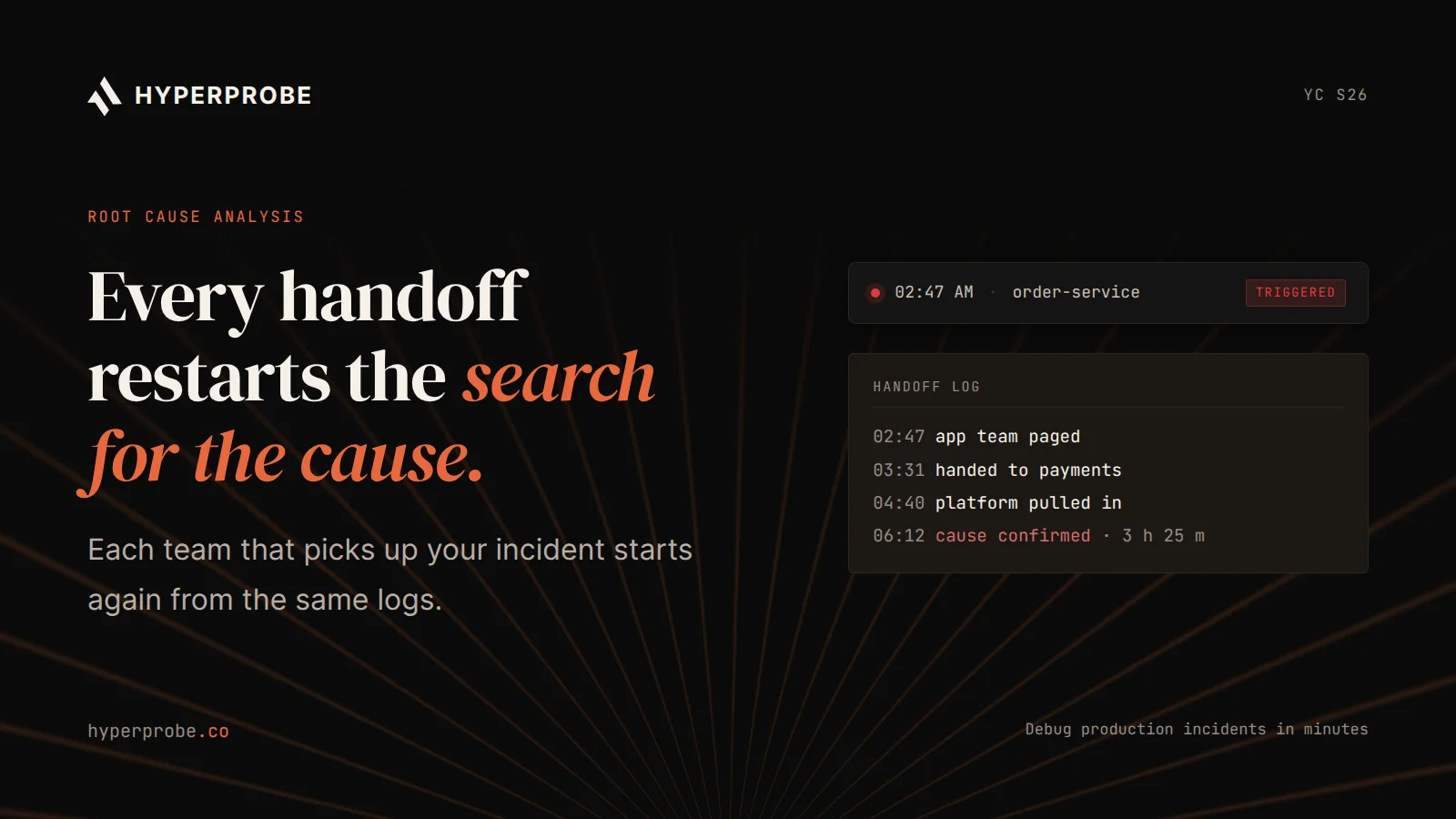
Checkout latency crosses the alert threshold at 14:07. The gateway team sees elevated p99 but normal error rates. The payments team sees a slight rise in retries from upstream and nothing else. The inventory team's dashboard is green. Three teams, four services, and forty minutes later the only agreement in the incident channel is that it is probably someone else's service.
Root cause analysis in software is the process of identifying the underlying defect, change, or condition that produced an incident, as opposed to the symptom that triggered the alert. When a single team owns the whole path, the work is mostly debugging. When the path crosses team boundaries, the work becomes something else, and that something else is where the hours go.
An earlier guide covered where backend teams lose hours in a production incident phase by phase. This one goes a level deeper into the investigation phase and asks why it stretches so far when more than one team is involved.
What root cause analysis in software means
Root cause analysis answers a different question from incident response. Response asks how to stop the damage. Root cause analysis asks why the damage started, in enough detail that the same failure cannot recur through the same path.
Google's own description of how its on-call engineers work shows the ordering. The responder detects, assesses blast radius, decides whether to escalate to other teams, mitigates, and only then enters what the authors call the root-cause loop, which often involves significant code changes and postmortem documentation. Mitigation comes first because it has to.
That ordering has a consequence that incident data makes visible. In a study of 152 high-severity incidents at Microsoft Teams, 40% were caused by code or configuration bugs, yet nearly 80% were mitigated without a code or configuration fix. Rollbacks, failovers, and restarts bought the service back. The reason it broke was still open when the pager went quiet, and for incidents spanning several teams, it often stayed open for days.
Why the clock keeps running after mitigation
A closed incident ticket and a known root cause are two different states, and the gap between them is paid for in engineering hours rather than downtime minutes, which is why it rarely shows up on an executive dashboard.
The Cockroach Labs State of Resilience survey puts the average outage time to resolve at 196 minutes, and 39% of respondents said outages generate extra post-mortem and investigation work on top of that. Only 57% described their response as even moderately organized.
Meanwhile the Catchpoint SRE Report 2025 found median operational time rising from 25% to 30% of an engineer's week year over year. Cross-team root cause analysis is one of the quieter contributors to that number. It is spread across several calendars, rarely tracked as a single line item, and easy to mistake for ordinary collaboration.
Five places cross-team RCA stalls
The stall points below show up repeatedly in published incident studies and in the postmortems teams write for themselves. Each one is a seam between two teams rather than a flaw inside one.
Every team's dashboard is green
Teams monitor what they own. A service that returns a well-formed response in 40 milliseconds looks healthy to the team that built it, even when that response carries a stale value the next service downstream will choke on.
The Microsoft study found that automated monitors caught only about 55% of incidents; customers reported 29% and partner teams inside the company reported another 10%. The authors flagged a category they called "external effect," where every monitor on the service side behaved as designed and the failure was only visible from the partner application, which had no monitor for it.
The same study's fifth finding is the one managers should pin to the wall: time to detect and time to mitigate were significantly higher for code bugs and dependency failures than for any other root cause category. Dependency failures are, in practice, cross-team failures. A guide from the Computer Measurement Group describes the underlying problem as a missing shared mental model, where overreliance on tribal knowledge leaves no one able to picture how the services actually interact.
Nobody owns the seam
A bug inside a service has an owner. A bug in the contract between two services, such as a field that one side started sending as null and the other side never expected, has two owners and therefore none.
The Microsoft postmortems show this in the paperwork. Half of the documentation-related mitigation delays traced back to troubleshooting guides that could not answer basic questions, including which team to engage for a code change. A separate category, "external dependency," captured incidents where a communication gap with the partner team delayed their engagement entirely.
A case study of 107 incidents during a multi-year microservice decomposition describes the standard flow as mitigate first, then identify and hand off to the responsible team. The authors concluded that cross-team collaboration could have prevented the same incident from recurring in different domains. Each team fixed its own copy of the problem, and the seam stayed unowned.
Evidence does not line up
Even when the right people are in the channel, they are usually looking at different data. One team samples traces at 1%, another at 10%. One logs request IDs, another logs session IDs. Trace context gets dropped at a queue boundary. Retention differs, so by the time the second team joins, the first team's logs from the critical window have rolled off.
TechTarget's analysis of enterprise RCA describes the result as an incomplete, inconsistent view that leads to duplicated or conflicting remediation, with each team collecting its own data and running its own analysis.
The Microsoft numbers quantify how much of the slow part is evidence rather than reasoning. Among incidents with a complex root cause, 27% of the delay came from missing telemetry for the metric that mattered, and 55% came from time spent debugging the code change itself. In a cross-team incident, both costs multiply, because the missing telemetry sits in someone else's service and the code change was made by someone who is not in the room.
Access and approvals gate the next step
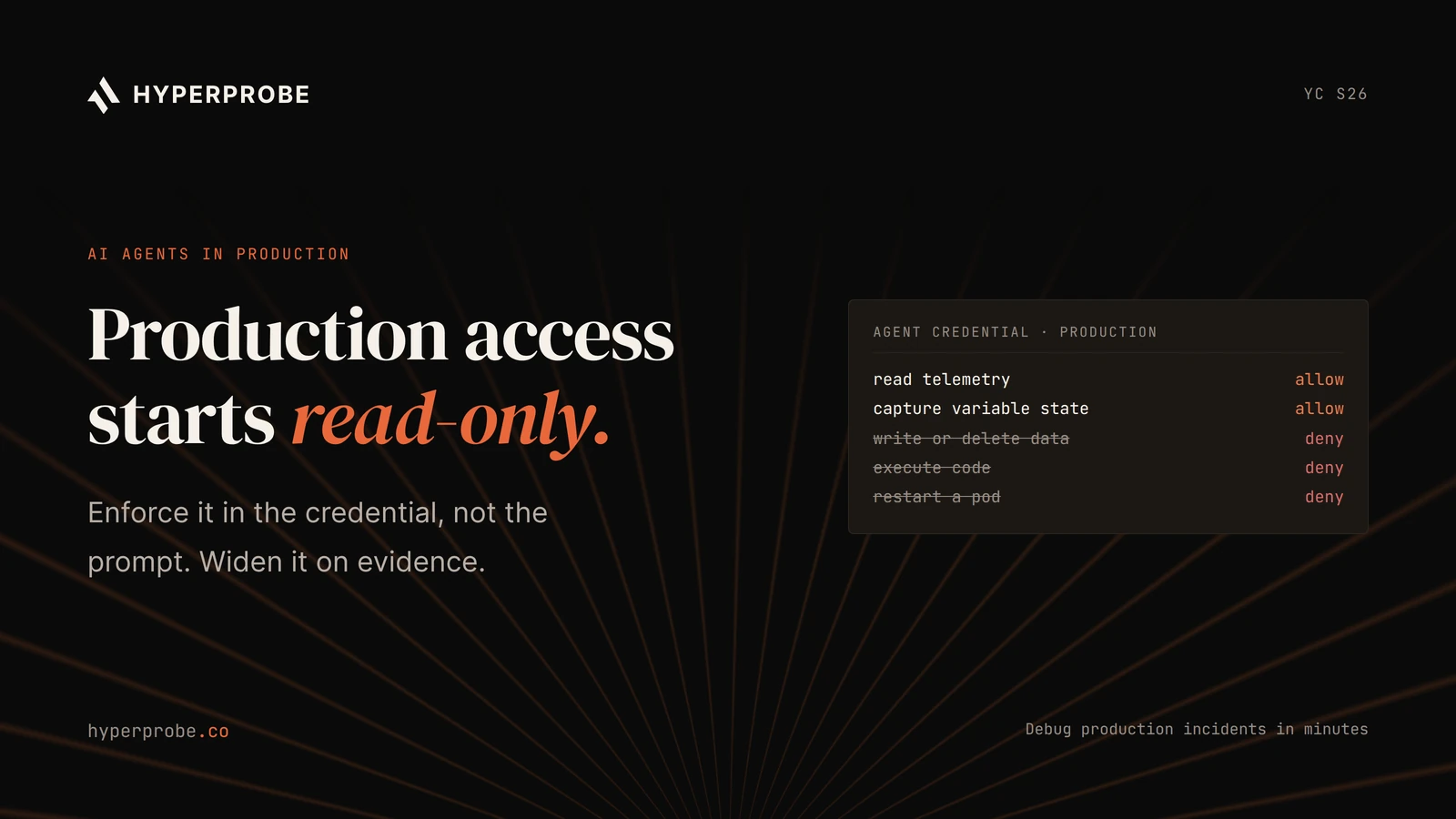
The engineer who can reason about a failure is frequently not the engineer who can read the logs or flip the flag. Reading someone else's logs needs a role grant. Disabling someone else's feature needs an approval. Attaching a debugger to someone else's pod is out of the question.
The Microsoft study found that even after a root cause was identified, 30% of incidents still had mitigation delays. Of the deployment-related delays, a quarter came from external manual approvals and another quarter from on-call engineers lacking permission to access log files or disable faulty features. The remaining half came from slow propagation of the change once approved.
This is the most fixable category on the list and the least frequently fixed, because every grant feels like a security exception rather than an operational necessity. For teams working with regulated data, the earlier guide on how to debug production without storing customer data covers how to widen diagnostic access without widening data exposure.
Too many people, too little shared context
Google's engineers observed that as more people join an investigation, communication channels among teams grow, and handoffs become the critical path. A five-person bridge has ten possible conversations. A fifteen-person bridge has over a hundred.
The Microsoft data describes the failure mode as "OCE avalanche," where multiple on-call engineers executed steps simultaneously without proper communication, accounting for 14% of manual-effort delays. Misdiagnosis, where the wrong resolution was executed because the problem was initially read wrong, accounted for 29% of the same bucket.
Coordination also has a cost after the incident. incident.io's analysis of its own customer data argues that assembling responders, gathering context, and switching between tools dominates incident duration, and that reconstructing a timeline by hand takes 60 to 90 minutes per postmortem. Across three teams with three different notions of when the incident started, the reconstruction itself becomes a negotiation.
How to shorten cross-team root cause analysis
The stall points above are structural, so the fixes are structural too. None of them require replacing the observability stack already in place. They require agreeing, before the next incident, on what evidence looks like and who is responsible for producing it.
Agree on what counts as evidence
Google's SRE Workbook sets a bar for postmortems that applies equally well mid-incident: conclusions must be based on data, with sources linked, and every participant should help author the record. Write down, in the runbook, what closes a cross-team root cause investigation. A captured value or trace that reproduces the failure path qualifies. A plausible story that the most senior person in the channel stopped arguing with does not. Making the standard explicit removes the quiet incentive for each team to prove the fault lies elsewhere.
Map dependencies before the incident
The CMG guide recommends building a dependency map that reflects how services interact across team boundaries, then using it to trace the first occurrence of the symptom back to its origin. TechTarget's suggested model adds a named point person per team who coordinates around the shared ticket. Keep both artifacts beside the runbook: a one-page map of which team owns which edge, and the person to page when that edge misbehaves. Review it every time a service is added or split.
Capture state at the boundary without a redeploy
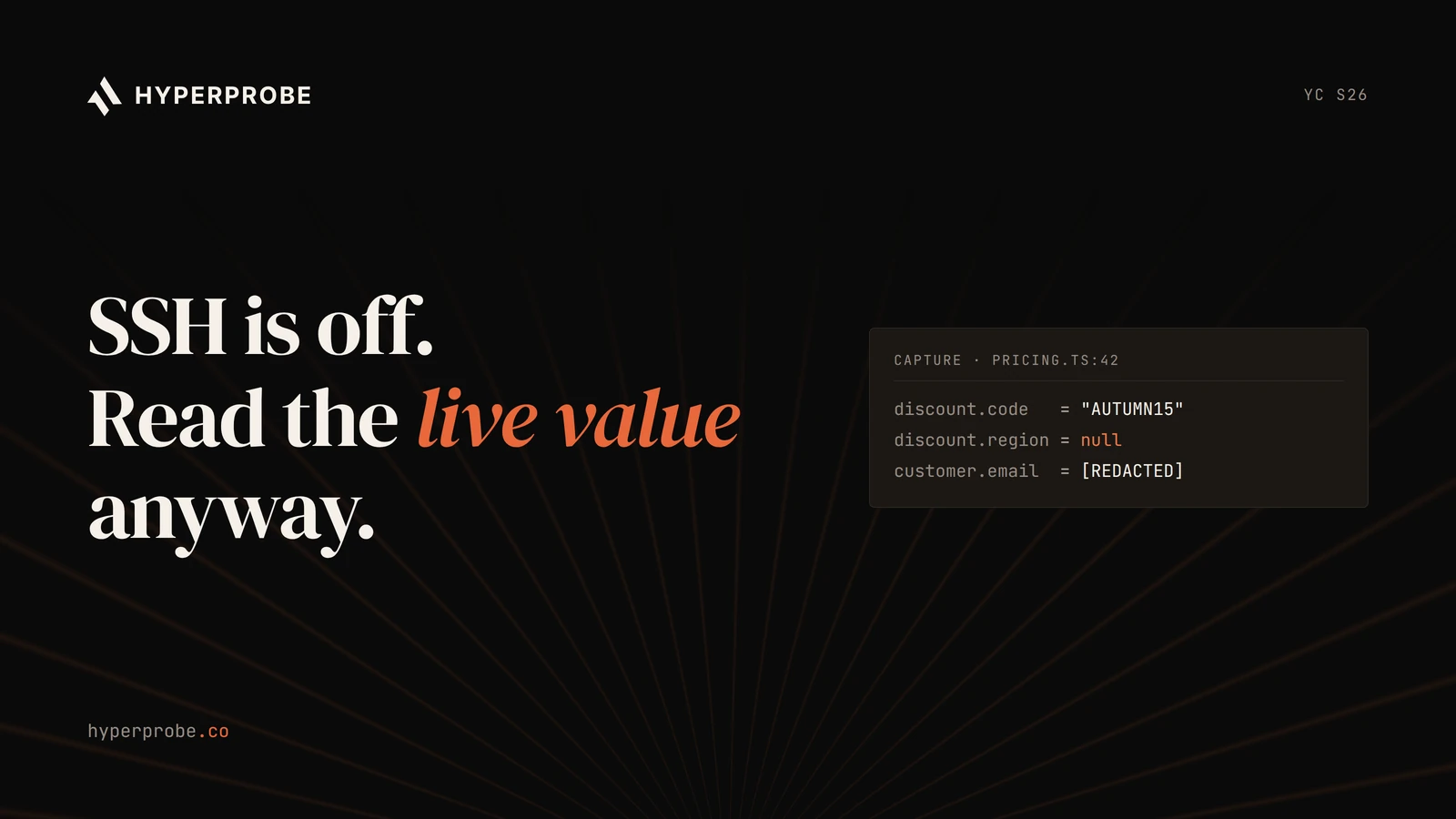
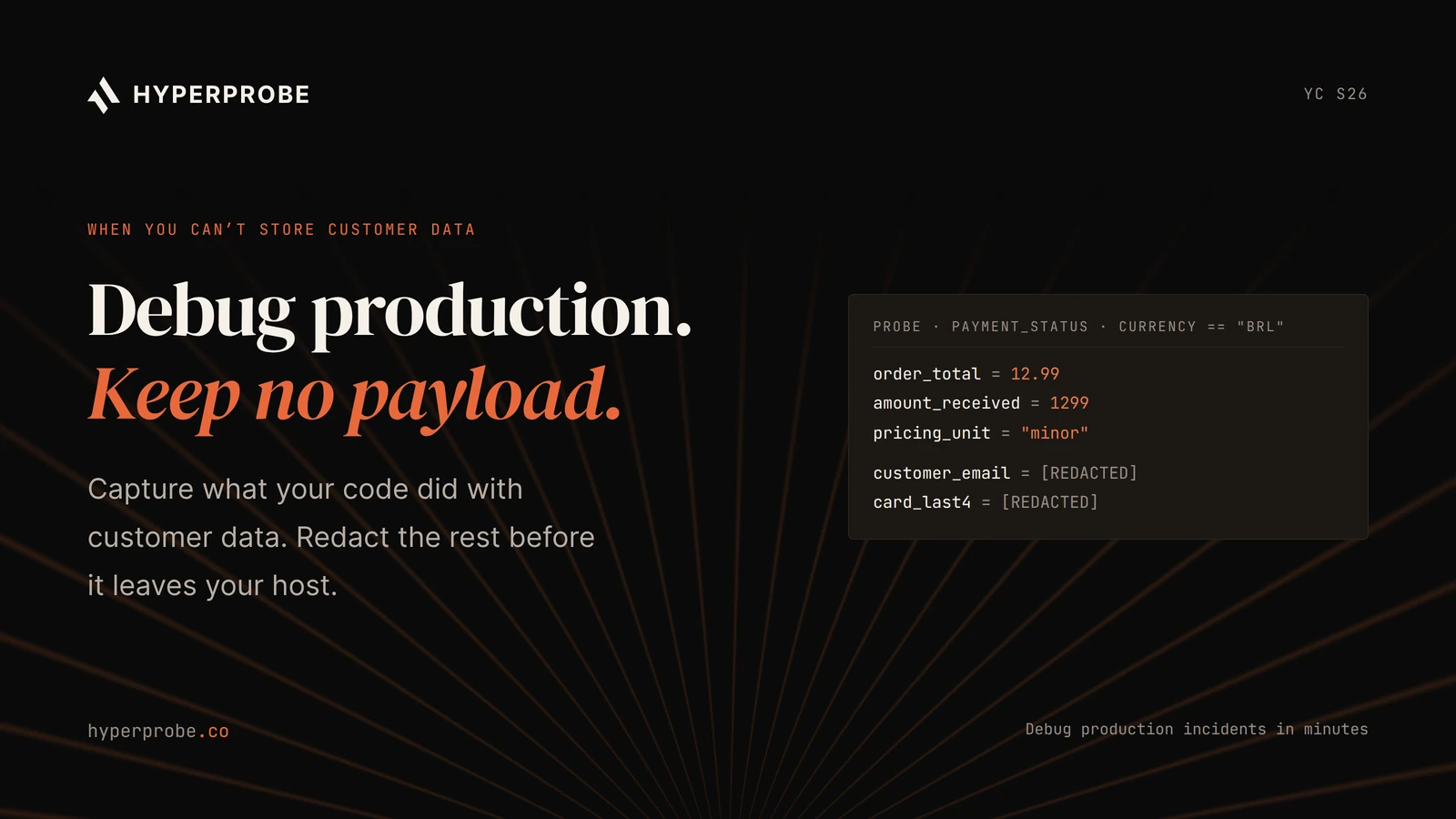
The evidence problem has a direct remedy. Instead of asking the upstream team to add a log line, ship it, and wait for the failure to recur, place a read-only probe on the handoff point in the running service and capture the payload as it crosses. Dynamic instrumentation does this without a code change or restart, and when PII redaction runs at the agent before anything leaves the process, the capture is safe to share across teams.
That turns an argument between two hypotheses into a look at one fact. A comparison of production debugging tools by what each can see explains where this sits relative to logs, traces, and profilers, and the guide to root cause analysis tools for intermittent 500 errors works through a cross-service example in detail.
Where an AI on-call agent fits
Each of the five stall points is, at bottom, a shortage of trustworthy evidence at a boundary. HyperProbe is built to work that boundary. When an alert fires, the agent forms hypotheses from the existing telemetry, places bounded read-only probes on the suspect code paths across the services it is installed in, captures the variables and payloads those probes see, and presents the confirmed root cause alongside the evidence that supports it. The engineer reviews the evidence and commits the fix; the agent does not open a pull request or change control flow.
Every probe carries a time to live, a rate limit, and a hit expiry, so it clears itself. Every placement and capture lands in an immutable audit log, which is what makes cross-team access defensible to a security reviewer. Pricing is per service with unlimited probes and captures on every plan, and the first real incident worked through with HyperProbe is free, which is a reasonable way to test the claim on an incident that already spans teams.
Conclusion
Root cause analysis in software takes a long time across teams because the system is larger than any single team's view of it. Each dashboard reports on the service its team owns, and access follows the org chart rather than the failure path, so the seam where the failure happened belongs to nobody and is visible to nobody.
Shared, verifiable evidence captured at that seam changes the dynamic, because it gives three teams one fact to reason from instead of three stories to defend. Write down the evidence standard and the ownership map before the next incident, and make sure the investigation can capture state where the handoff happens. Then run the next cross-team incident with HyperProbe and compare how long the root cause takes to confirm.