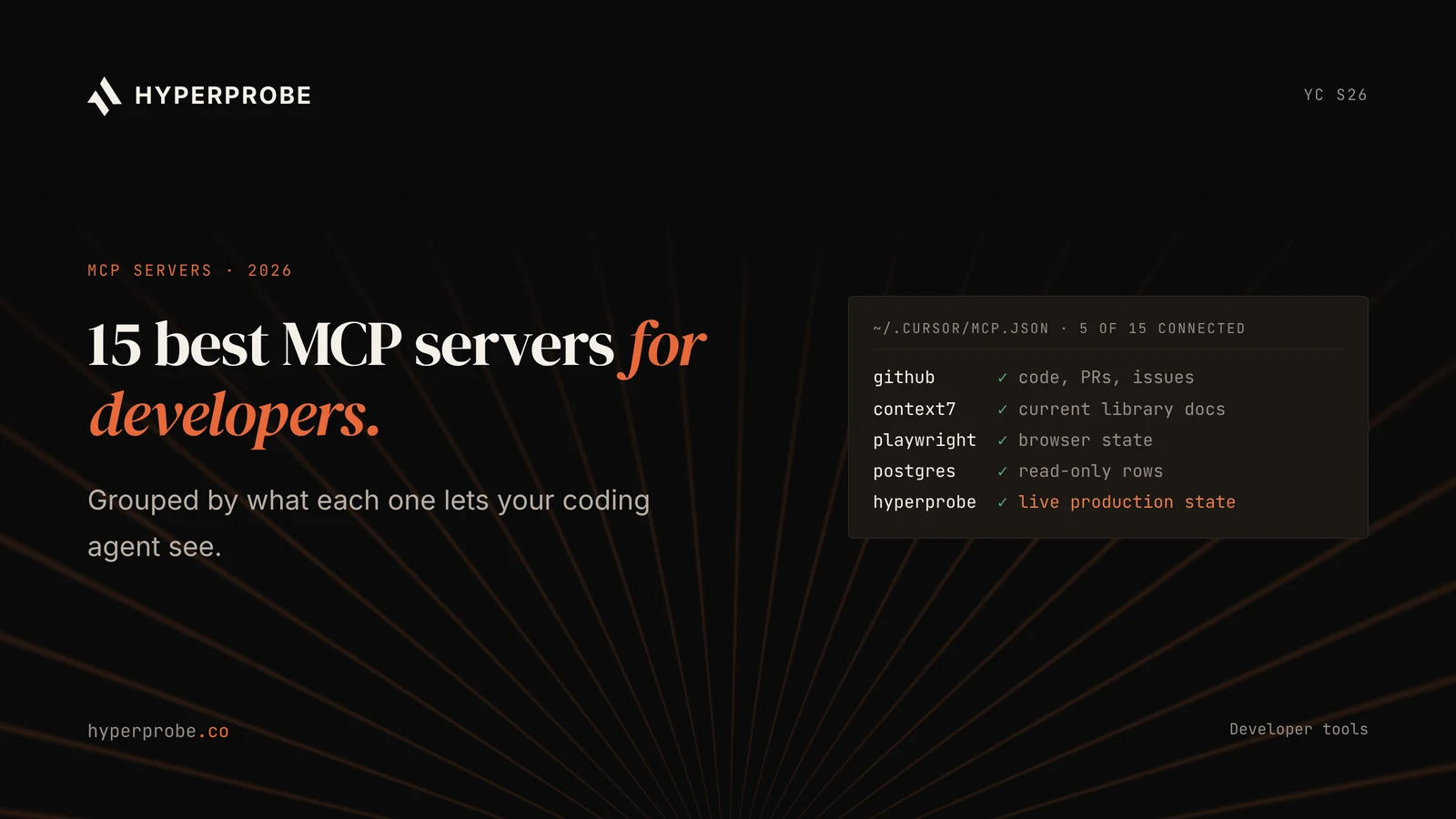
15 Best MCP Servers for Developers

Key takeaways
- The best MCP servers for developers return evidence a coding agent cannot read from the repository on its own, such as browser state, database rows or production errors.
- The official MCP Registry listed 60,398 servers on 9 November 2026, and 14% carry a verified problem, so official or actively maintained servers should be the default choice.
- HyperProbe leads the list because it captures variable state that was never logged, while observability servers return only data that was already collected.
- GitHub and Context7 belong in every setup; the other servers earn a slot only when the agent needs what they expose.
- Every server should start in read-only mode with a scoped, short-lived token, and write actions should require human approval.
The best MCP servers for developers in 2026 are the ones that hand a coding agent evidence it cannot get from the codebase alone. The official MCP Registry listed 60,398 unique servers on 9 November 2026, up from 15,494 on 8 July 2026. At that volume, the work shifts from finding a server to deciding which fifteen deserve a token.
This guide groups the servers by what they let the agent see, and each entry states what the server returns, how it authenticates, and where its evidence stops.
What makes an MCP server worth installing
An MCP server earns a slot when it returns evidence the agent needs for a task and exposes that evidence with a read-only scope by default. Three filters shaped this list.
The first filter is maintenance. The MCP Census found that 8,532 registry entries, or 14%, had at least one verified problem, such as an archived repository or a deprecated package, so every server below is either vendor-published or maintained by an active open source team.
The second filter is scope. Servers with a read-only flag or a scoped OAuth client ranked higher, because a single read-write token forces the agent to carry write access for read-only work.
The third filter is adoption, measured by weekly npm downloads and GitHub stars, because a widely used server gets its bugs reported. The protocol itself is stable, since it is governed by the Linux Foundation's Agentic AI Foundation, which passed 300 members in October 2026, so a server configured today will keep working across Cursor, Claude Code, Codex and VS Code.
Which MCP servers help during an incident
The first server in this group captures state that was never recorded, and the next three return what the system already recorded. That difference decides whether an investigation ends with a confirmed cause or a plausible guess, as covered in the earlier post on MCP servers for debugging production.
1. HyperProbe MCP server
The HyperProbe MCP server lets a coding agent place a read-only probe on a specific line of a running service, wait for the line to execute, and read the captured local variables, stack and arguments as part of its own reasoning. Cursor, Claude Code, Codex and opencode connect to it. The probe never pauses the process, PII redaction runs inside the host-side SDK before a capture leaves the machine, and every placement lands in an immutable audit log. The server is included on the Free tier for one service, and it fills the gap the other fourteen servers leave open, which is the variable that was never logged. The post on inspecting live production variables without logs walks through one capture end to end.
2. Sentry MCP
The Sentry server brings the issue, the stack trace and the release that introduced it into the coding session, along with Seer's root cause analysis. It runs as an official remote endpoint at mcp.sentry.dev/mcp. It is the right first observability server for exception-driven failures, and it cannot help when the request returned the wrong value without throwing.
3. Grafana MCP
The Grafana MCP server is open source under Apache 2.0 and runs self-hosted or against Grafana Cloud. It queries metrics and logs, reads dashboards and alert rules, and lists incidents and OnCall schedules. Authentication uses a service account token for the self-hosted server or OAuth 2.1 for the hosted version, so the agent inherits the permissions of that account and nothing more.
4. PagerDuty MCP
PagerDuty's hosted server exposes browse_incidents, browse_services and browse_schedules for reading, plus manage_* tools for writes, and authenticates with OAuth or a user API key. The self-hosted repository is archived, and tool filtering is not available yet on the hosted server, so a scoped OAuth client is the only way to keep the agent out of the manage_ tools during an investigation.
Which MCP servers cover code and docs
Four servers give the agent the repository, the documentation and the ticket it is working from.
5. GitHub MCP server
The GitHub MCP server is the official server for repositories, issues, pull requests, Actions runs and code security alerts. It runs as a hosted remote endpoint at api.githubcopilot.com/mcp with OAuth, or as a local Docker image with a personal access token. The server supports toolset selection and a read-only mode, which keeps a review task from carrying merge permissions. Teams that already run gh from the terminal can skip it, since the CLI covers the same reads without a second token.
6. Context7
Context7 returns documentation for the exact library version in the project, which stops the agent from writing code against an API that changed two releases ago. The Upstash package records 1,054,636 weekly npm downloads and runs either remote at mcp.context7.com or local through npx. It reads only public docs, so it needs no token and carries no write risk.
7. Serena
Serena gives the agent symbol-level navigation through language servers, so it can find a function definition or every call site without grepping the whole tree. The open source project matters most on large monorepos, where file-based search floods the context window.
8. Linear MCP server
The Linear server supplies the issue the agent is working on, its comments and its linked pull request. It is an official remote server at mcp.linear.app/mcp. Keep write tools such as status changes behind a confirmation step so the agent does not close a ticket on its own.
Which MCP servers handle browser testing
Three servers let the agent drive a real browser and read what the page actually did.
9. Playwright MCP
Playwright MCP is the most installed server in the ecosystem, at 10,233,094 weekly npm downloads. It drives Chromium, Firefox or WebKit through the accessibility tree rather than screenshots, so the agent reads structured page state. Install with npx @playwright/mcp@latest. It belongs in any project that has a UI.
10. Chrome DevTools MCP
Chrome DevTools MCP exposes the console, the network panel and performance traces from a live Chrome session. It records 1,868,745 weekly npm downloads. Use it when the question is why a page is slow or which request returned a 500, since Playwright reports what happened on the page and DevTools reports why.
11. Browser Use
Browser Use handles sites without an API, including login flows and multi-step forms. It is an open source project. Run it in an isolated browser profile, because any site the agent visits can inject instructions into the page the agent reads.
Which MCP servers reach data and deploys
Four servers connect the agent to the database and the platform that runs the service.
12. Supabase MCP
The Supabase server lets the agent query tables, write migrations, inspect logs and check row-level security policies. It runs as an official remote endpoint at mcp.supabase.com/mcp. Enable the read-only flag for investigation sessions and scope the connection to a development project before granting production access.
13. Neon
Neon's server creates a Postgres branch, runs a migration against it and reports the result before anything touches main. Database branching gives the agent a safe place to test schema changes. The project is smaller than the others here, but the vendor maintains it, but the vendor maintains it.
14. Vercel MCP
Vercel's official server at mcp.vercel.com runs over OAuth and returns deployment logs, project settings and analytics. When a preview deploy fails, the agent reads the build output directly instead of asking an engineer to paste it. The connection carries the same access as the signed-in Vercel user, so Vercel's own docs recommend human confirmation on every write. Its evidence stops at the platform boundary: it reports that a function threw, without the variables it held.
15. Cloudflare MCP
Cloudflare's API server at mcp.cloudflare.com/mcp exposes more than 2,500 API endpoints through a search-and-execute pattern, with separate servers for documentation, containers and browser rendering. It suits teams whose backend runs on Workers, KV, R2 or D1 and who want the agent to read the deployed configuration rather than guess from the source. OAuth is required, and account-scoped tokens keep the agent inside one account.
How to run MCP servers safely
Start every server in read-only mode and widen scope per task, never per installation. The OWASP MCP Security Cheat Sheet lists tool poisoning, rug pulls, cross-origin tool shadowing, over-privileged tokens and prompt injection through tool output as the primary risks when several servers share one agent session.
The rules below keep those risks contained without blocking the work.
- Issue a scoped, short-lived token per server, and never reuse a personal admin token across servers.
- Pin tool definitions and alert on changes, since a server can swap a benign tool description for a malicious one after approval.
- Require a human confirmation for any tool that writes, deletes, deploys or sends.
- Keep an audit log of every tool call, its arguments and its result, so an incident review can reconstruct what the agent did.
The earlier piece on whether AI agents should access production systems explains why read-only has to come first when a server touches production.
Best MCP servers to install first
GitHub and Context7 belong in every developer's configuration, because nearly every task needs the repository and current documentation. After those two, add servers by evidence gap rather than by popularity. A frontend task calls for Playwright, a schema change calls for Supabase or Neon, and an incident calls for Sentry or Grafana to read what was recorded plus a probe to capture what was not.
Evidence gathering takes the largest share of an incident's clock, as the breakdown of where backend teams lose hours in a production incident shows, and the comparison of root cause analysis tools covers which tools close that gap. To test the probe path, install the HyperProbe SDK on one service, connect the MCP server to the coding agent already in use, and ask it to confirm the next 500 error with captured state. The root cause analysis page shows what that confirmation looks like.

Frequently asked questions
What is an MCP server?
An MCP server is a program that exposes tools, resources and prompts to an AI application through the Model Context Protocol, an open standard governed by the Linux Foundation's Agentic AI Foundation. A coding agent such as Cursor or Claude Code connects to the server, calls a tool such as a log search or a database query, and reads the structured result as part of its reasoning.
Do MCP servers work with Cursor, Claude Code and Codex?
Yes. Cursor, Claude Code, Codex, VS Code with Copilot and opencode all support MCP, and most official servers now run as hosted remote endpoints with OAuth, so one sign-in configures the server for whichever client a developer uses. Local servers run through a single command such as npx @playwright/mcp@latest.
Are MCP servers safe to connect to production systems?
They are safe when scoped correctly. The OWASP MCP Security Cheat Sheet lists tool poisoning, over-privileged tokens and prompt injection through tool output as the main risks. Start each server in read-only mode, issue a scoped short-lived token per server, require human confirmation for any write, delete or deploy action, and keep an audit log of every tool call.
How many MCP servers should a developer install?
Start with two, GitHub and Context7, since nearly every task needs the repository and current documentation. Add a server only when the agent needs evidence it cannot reach, such as Playwright for browser state, Supabase or Neon for database checks, Sentry or Grafana for recorded telemetry, and HyperProbe for variable state that was never logged. Each extra server widens the token surface, so fewer is safer.
Written by
Founder
Shailendra Singh is the founder and CEO of HyperProbe (YC S26), an AI on-call agent that debugs production incidents by capturing evidence directly from running services. He has over a decade of experience building and running production systems, starting at Applied Materials before moving into startup operating and engineering leadership roles, including at a company that later became a unicorn. He founded and ran Transporter.city from 2017 to 2021, then spent three years building HyperTest before founding HyperProbe with Karan Raina. He writes about production debugging and incident response.
RELATED READS